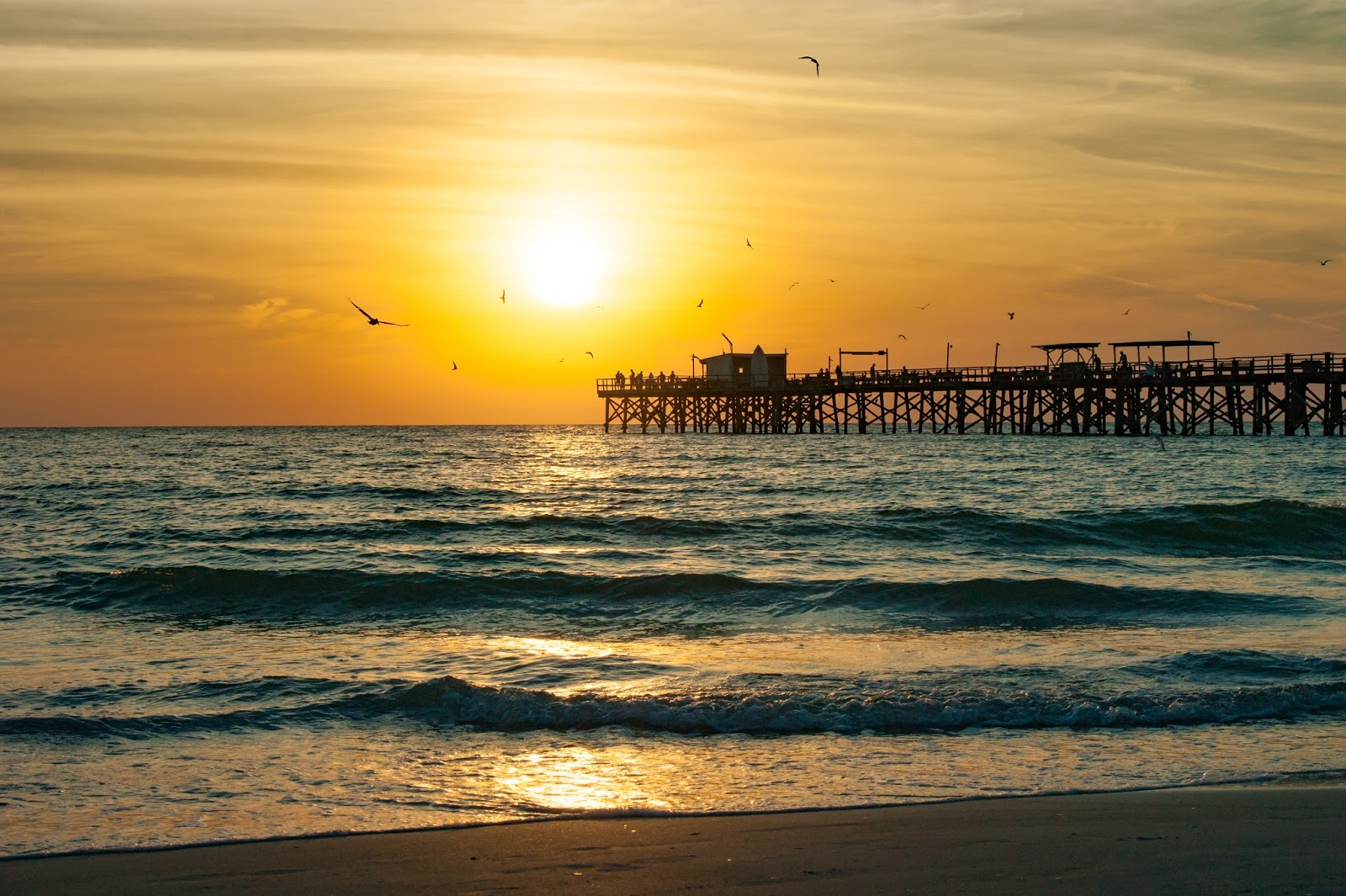
Treasure Island Sunset

Treasure Island Sunset

Monday, September 19, 2016

To Get That Great Photo You Want - Just Be There

You've probably heard the old saying that "80% of life is just showing up." Well, the truth is that photographic success is kind of similar.

You can have the best gear and know all the great techniques. But if you aren't putting yourself out there in the field regularly enough, you just aren't going to get the results you want. This is especially true in nature and wildlife photography. Of course, as a nature photographer, I do my best to put myself in the right place at the right time to get the shot that I am looking for. But honestly, nature has a mind of its own.

Sometimes, it all works according to plan and everything falls in place. More often though, it's a struggle to acquire the images you have in mind. This is because all sorts of factors are in constant flux. The time of day and therefore the position of our light source, the sun, is always moving, albeit kind of slowly. The weather can change in an instant. The animals themselves can change their behavior and simply not be available at times. And on it goes ....

But there is one equalizing factor to all of this uncertainty - being there often. The more chances you give yourself to get the shots you want, the more you will find that good and fortunate things just seem to happen to you in the field.

Case in point - a few days ago I went to the Circle B Bar Reserve in our local area to spend a few hours there, as I can usually come away with something that I'm pleased with even if it's not what I expected. But I was so disappointed to find that a couple of the main trails had been closed by the officials, in many cases because of dangerous alligators. I only found a few wading birds on the trails I was allowed to use, so I was not a very happy photographer at that point.

But as I was heading back to the parking lot, sure enough, serendipity happened! All of a sudden, a mature red-shouldered hawk just appeared out of nowhere and landed on a branch within 10 yards of me. Not only that, he wasn't even bothered by my presence at all, so he just stayed on the branch and gave me pose after pose as I clicked away for about 20 minutes. I tried different angles, compositions, and lighting. And through it all he just patiently stayed put and looked around.

Later on that day, I was just thinking how disappointed I was initially about the trails being closed at Circle B Bar. But just because I was there, a very fortunate occurrence happened that I've never experienced before. It wasn't due to my skill as a photographer, or to anything I had planned for this outing. It was just simply because I was out there making myself available to whatever nature would send my way.

Now, let me be clear. Nature doesn't doesn't always throw me a bone like this on slow photographic days. But, I find that the more I make myself available to nature, the more serendipitous success I have.

So, if you aren't happy with the images you are getting lately, maybe you just need to put yourself out there in the wild more often!

Here are a few of the shots I took of that red-shouldered hawk:

Red-shouldered hawk

Red-shouldered hawk with backlighting

Red-shouldered hawk from a different angle


See my latest nature and wildlife images at:
www.duanelipham.com
Follow me on Google+

Tuesday, September 13, 2016

Photographing The Long Piers Of Florida

One thing Florida has plenty of is coastline on both sides of the state. And wherever there is a long stretch of seacoast you can usually find a long pier that juts out into the water for fishermen to enjoy.

On the west side of Florida, the side that faces the Gulf of Mexico, you also get the advantage of having incredible sunsets over the water. And since you don't have anything in the way between you and the horizon when the sun sets over the gulf, you often get this incredible big ball of a sun just before it actually dips below the horizon and disappears.

Then if you add a long pier in the shot for foreground interest, you can get some pretty spectacular sunset shots. Also, many of the larger birds like to hang around the pier to feed on the small fish hiding in the shadows underneath and also the spoils that the fishermen leave behind, so if you happen to catch them flying around the pier at the same time that the sun sets, that's a great image to capture as well.

One of my favorite piers to photograph on the gulf coast is the Redington Long Pier. The owner has a a reputation for not being very cooperative with photographers, so you may have to search for a good parking space, but usually one is available on Gulf Blvd. within pretty easy walking distance.

Another pier that I visited just a few weeks ago is the Venice Long Pier. It's situated really close to a public parking area, so getting a close parking spot is easy to do.

Taking photos of these piers can be done in a wide variety of ways, ranging from wide-angle to telephoto. The key is knowing how much of the pier to include in the shot, because you can rarely get a good composition that includes the entire pier.

Here are a few shots I have taken with different lenses, of the piers I mentioned above:

Redington Long Pier during a cloudy sunset (notice the birds flying)

The sun setting behind the Redington Long Pier on a clear day

The Redington Long Pier after sunset during blue hour

A telephoto shot of the Venice Pier at sunset

A long exposure shot of the Venice Pier just after sunset

As you can see, you have a lot of options for shooting long piers and they don't have to be at sunset either. In fact, when the sun goes down and the lights come on, that can produce some of the best long pier shots when the orange and red of the sunset is still visible just over the horizon.

And long exposure shots can be spectacular if you have the right combination of weather conditions and cloud formations helping you along. So if you have a long pier in your area, why not scout out a good spot for sunrise, sunset or blue hour shots including the pier?


See my latest nature and wildlife images at:
www.duanelipham.com
Follow me on Google+
Monday, August 29, 2016

Shooting A Beach Sunset With A Telephoto Lens

One of the great perks of living in Florida is that the beach is never very far away no matter where you live in the state. For us, it's a little over an hour away on the gulf side. And there are several great photo subjects that can be found on the beaches of the Gulf Of Mexico, but not much can compare with the unbelievable beauty that happens almost daily when the sun sets over the water.

I have traveled around the country and lived in various other places, but I have never seen anything like the glory of a Florida gulf-side sunset. Of course, if the weather is not cooperating and there is heavy rain and thick clouds, it may not turn out as spectacular as you would like. But if the conditions are right, the sky just lights up with warm colors that gradually blend into each other like yellows, oranges, reds and even purples.

How you choose to capture the image of a Florida sunset is largely a matter of taste, but I notice that most photographers seem to like using wide-angle lenses. This is a great choice and makes incredible photos, but the down-side is that the sun becomes just a small dot with this kind of image.

But here in Florida, since you get to see the entire sunset as the sun goes all the way down on the horizon over the water with nothing of any substance in its way, the sun becomes a big red ball and appears very large just before it slips under the horizon's edge. So how do you convey this kind of effect in a photograph?

One way is to use a telephoto lens. Of course, this takes much of the foreground out of the picture, but why not make the sun the star of the show anyway? For instance, I like to use a fishing pier as a foreground object that is large enough to provide some kind of scale in the image if I can. You can also use a sailboat or yacht in the photo if it is available.

Here are a few shots I took recently at a couple of gulf-side beaches here in Florida using a 300mm lens:

The Venice FL pier at sunset

A sailboat at sunset

A large boat at sunset


In all of these shots, the sun was not altered in any way in post-processing. The size of the sun is in these pictures is more in line with what you actually see as the sun sets over the water here in Florida. A good telephoto lens helps capture that look and feel and that makes it a valuable tool in your bag for beach sunsets.


See my latest nature and wildlife images at:
www.duanelipham.com
Follow me on Google+

Tuesday, August 16, 2016

Why Be A Nature Photographer?

There are so many tutorials and blog posts about the nuts and bolts of photography. Articles that recommend certain equipment, showcase a particular location, or provide tips on how to achieve a particular look in your images. My blog is no different. The majority of my posts have to do with the same kinds of subject matter.

But, every once in a while, it's a good idea to step back and see the forest, not just the trees. In doing so, we can ask that all important question - why? Why am I a nature photographer? Why do I enjoy it so much?

There are a myriad of reasons that try to answer that question, but today I'll discuss just a few of the major thoughts that come to mind when trying to answer why I am a nature photographer in the first place.

Perhaps the first thought that commands attention is the peace that nature and wildlife photography brings to my soul. In daily mundane life, there is a lot going on. Appointments to meet, people to see, situations that demand immediate attention. Frankly, it eventually gets wearing, both physically and emotionally. This is so even if you enjoy what you do in your daily life.

But when you step out into nature, the world just seems to slow down to a much more pleasing pace. You can actually become more aware of what is going on around you. Even small things that you wouldn't normally notice in everyday life can seize and arrest our attention for a time. The noise of the busy world fades away and we become aware of the songs of birds, the quiet of a peaceful reserve, the softness of water lapping against the shore of a lake, and much more. Time loses its hold over us.

We become sensitive to the ever-changing light that surrounds us and how light and dark shadow create interesting contrasts in even the simplest of subjects in sight. Our imagination is fed and nurtured, and soon we see textures and symmetry that we would never have appreciated if we were not looking for them. There is much greater depth to the world when we see it with curious and caring eyes.

That leads me to another major reason why nature photography is so important to me personally - it fills me with a sense of gratitude and thankfulness for all that is around me. I didn't put those amazingly beautiful and intricate plants, animals and ecosystems in place. And yet there they are in all their glory and splendor. Great appreciation fills my heart, and it feels good, it feels right!

As I said there are many more reasons why I enjoy nature and wildlife photography so much, but this post won't begin to cover them all. It's just a beginning. I'll come back to this subject again in the future and explore it in more detail. For now, here are a few images from recent walks in nature that I remember well and highly prize:

Roseatte Spoonbills gathering at low tide at Ding Darling Reserve

A burrowing owl perched in front of his home

A reddish egret foraging in the surf at sunset on Captiva Island


See my latest nature and wildlife images at:
www.duanelipham.com
Cherokee Sun on Facebook

Monday, August 15, 2016

Are Monopods Safe Or Hazardous In A Crowd?

During this past week my wife and I visited The Ringling in Sarasota, which features the house that John Ringling and his wife Mable built and enjoyed for several years while he owned the Ringling Brothers Circus. The grounds also boasts a circus museum and a fantastic art museum that the Ringling's built to share their impressive art collection with the outside world. Overall, the various features of the Ringling, including the grounds themselves, will take several hours to view and fully appreciate.

When I entered The Ringling I was provided with a map and instructions on the do's and don'ts while on the property. I quickly went to the section that discussed photography and saw that they did not allow tripods and selfie-sticks as well as professional lighting equipment to be used by photographers, especially when entering any of the buildings on the site. But otherwise, cameras themselves were permitted everywhere.

Since I didn't see anything in their material about monopods I felt safe in taking it with me. And while I was outside in the gardens no one said anything to me about it. But as I went inside each building I was often told that I had to check my monopod as it was not allowed inside the residence or the museums.

At first, I just complied, but as I went from one building to the next it became clear that the rules about monopods were not uniform, so I started to ask the reason why such a rule had been made. The response was that it was a safety hazard. When I pressed further to ask why it is considered a safety hazard I got some really bizarre answers and mostly bewilderment on the part of the staff that eventually ended with a simple "Well, you will have to take that up with management." It was clear that the staff was simply lumping monopods in with tripods and most did not know the difference.

Finally, the last employee I encountered actually discussed it very reasonably with me and came to the conclusion that since it was not mentioned in the prohibited photography equipment listed in the map and brochure of the estate, it was probably alright to use. I went ahead and checked it anyway though because I didn't want anyone to get in trouble with management on my account. But she was so impressed by the discussion that she said that she intended to bring the subject up at the next staff meeting to see if she can get the unwritten policy on monopods changed.

So now, after giving it further thought, I can easily see why an estate would not allow a tripod or selfie-stick to be used onsite because they extend out away from the photographer's body and can cause an unintended accident when others pass by and don't realize that they are there. But what objection can honestly be made about a monopod? It is attached to the underside of the camera so that the lens of the camera will usually extend out farther from the photographer than the monopod itself. And as long as it is carried in an erect position it should not be unmanageable or unwieldy.

Monopods are an invaluable aid in situations where light is low, such as the inside of buildings and residences. Although they are not as sturdy and stable as a tripod, they can often make the difference between getting a sharp and clear image in low light, and not doing so. I would hate to see monopods lumped in with other equipment that can be risky when used in a crowd. So, I recommend that if you face the same situation and are prohibited from using a monopod on the grounds of safety, have a polite conversation with the staff and see if you can educate and influence them to change their mind on the issue. It will help all of the rest of your photographer brethren if you do!

Here are a few shots I took using the monopod on the grounds of the estate:

White rose tinged with red

Pink rose bud

Yellow Zinnia


See my latest nature and wildlife images at:
www.duanelipham.com
Cherokee Sun on Facebook

Friday, August 5, 2016

Water Lilies At Naples Botanical Garden

In Florida, something beautiful is blooming almost any time of the year, and I've been to several botanical gardens in Florida's mid-section and gulf coast in search of the best flower images that can be found. Most of the botanical gardens I have visited have not disappointed either. In most cases, each one has a unique look. Some feature orchids and bromeliads, others cater to daisies, zinnias or coneflowers, and still others to flowering bushes and trees.

But if you want great shots of water lilies, the best place I have found so far is Naples Botanical Gardens. Of course, they have a great representation of all sorts of flowering plants and bushes. In fact, there are several areas dedicated to showcasing plants and flowers from all around the world, and so they have a Caribbean section, a Brazilian section, an Asian garden, an orchid garden and so on. But you can find fabulous water lilies almost everywhere on their grounds.

The facility itself is very well maintained, better than almost any other botanical gardens I have seen in Florida. It even has its own lunch cafe. And the grounds are pristine, even in the dead of summer. It takes a lot of work and attention to detail to pull off this level of floral beauty over such a large area, and they have succeeded on all levels. And I'm not the only one who thinks so either as the Naples Botanical Gardens currently has a 4.7 Google reviewer rating and it is well-deserved.

But water lilies are one of my all-time favorite flowers to photograph, so naturally I was drawn to them right away. Here are a few shots I got while I was there:

A purple water lily

I always love the blue and yellow water lilies

Water lily with reflection on the pond

So if you are a fan of the bright colors and symmetry of water lilies, I can't really recommend any place in Florida more than the Naples Botanical Gardens. And you will certainly enjoy the rest of the gardens as well.


See my latest nature and wildlife images at:
www.duanelipham.com
Cherokee Sun on Facebook

Monday, August 1, 2016

The Burrowing Owls Of Cape Coral

As a nature and wildlife photographer, I am always looking for new subjects. Many of the birds and flowers that I photograph are subjects that show up repeatedly in my work. And that's ok, because there will always be new and fresh ways to make images of the same subject, depending on the background, the quality of light, composition, and so forth.

But it really is a nice change of pace when you can work with a photo subject that you have never taken before. For me, the burrowing owls in Cape Coral, FL are just such a refreshing change. I had heard of these unique owls that actually build their homes in the ground instead of trees, but I had never seen them and certainly had no experience whatsoever in photographing them.

But since my wife and I planned to take a short vacation in the Fort Myers area, I figured it might be a great opportunity to check out these amazing birds. Fortunately, there is a great resource online that provides a map of some of the most common places where these owls can be found throughout the Cape Coral area. You can find that map here.

I am happy to say that the map was a great help and led us right to the owls on the first try. The map outlines five areas around the city where the owls have been known to make their home. In most cases, the map was right on. The only place that we could not find any owls was around Cape Coral's City Hall.

Apparently, this is not unusual as I understand that the owls move around from year to year and set up shop in a different location whenever they feel it is necessary to do so. For some reason then, city hall is no longer desirable real estate for the owls, at least not for this year anyway.

But the other locations on the map all had burrowing owl nests, some more than others. And these owls make for some great photo opportunities! They are easily accessible, there is usually not a crowd around, and as long as you aren't foolish and try to get too close, they put up with your presence without much complaint.

Here are a few burrowing owl images that I took while we in Cape Coral for the day:

A pair of owls perched outside their home

Talk about curious - this one thought we were pretty odd

Another owl pair in the tall grass

I highly recommend a long lens when working with these owls. I used a 500mm Tamron lens and it helped me get close without making them unduly frightened or anxious. You might get away with as little as a 300mm lens, but I personally could have have used as much focal length as I could get to help keep the images as natural as possible and throw the background out of focus.

So if you have a day or so to kill, try a new subject for your nature and wildlife photography, and visit the burrowing owls of Cape Coral.


See my latest nature and wildlife images at:
www.duanelipham.com
Cherokee Sun on Facebook